Roof inspection in Cedar Hill
The complete guide to a Cedar Hill roof inspection
Cedar Hill earns its name. The city sits on some of the highest ground in the Metroplex, and a roof up here catches wind and weather that lower-lying suburbs never feel. A roof in that setting deserves more than a glance from the driveway, so this is exactly what a thorough Cedar Hill roof inspection covers, why each part matters, and how we turn what we find into something you can actually use. The inspection itself is always free.
Why Cedar Hill roofs are more exposed
The ridgelines that give Cedar Hill its views also give its roofs a harder life. Elevation means less shelter, and the wind that rolls across the hills hits these homes with more force and more consistency than it hits the flats to the north and east. Steady wind is the quiet enemy of a roof: it does not always tear shingles off in a single dramatic event, it works at the edges day after day, lifting tabs, breaking seals, and prying at the ridge until a path opens for water. The first thing that shaped how we inspect in Cedar Hill is simple respect for that exposure.
The 1990s building wave, thirty years on
A large share of Cedar Hill went up in the early-to-mid 1990s, which means a very large number of these roofs are now decades into their service life. Even a roof that has been replaced once is likely on a covering that is ten or fifteen years old by now. That maturity changes what an inspection is looking for. We are not hunting for a builder's fresh mistakes here so much as reading how thirty years of Texas sun, heat, and storms have worn a roof down, and figuring out how much life honestly remains.
Storm country, on higher ground
Southwest Dallas County sees its full share of the hail and high wind that define North Texas springs, and Cedar Hill's elevation does nothing to spare it. If anything, exposed higher ground can take a storm harder. Because so much of the damage these storms cause is invisible from the ground, an honest inspection is the only way to know whether the last big cell that rolled through left your roof intact or quietly compromised.
Why a driveway glance is not an inspection
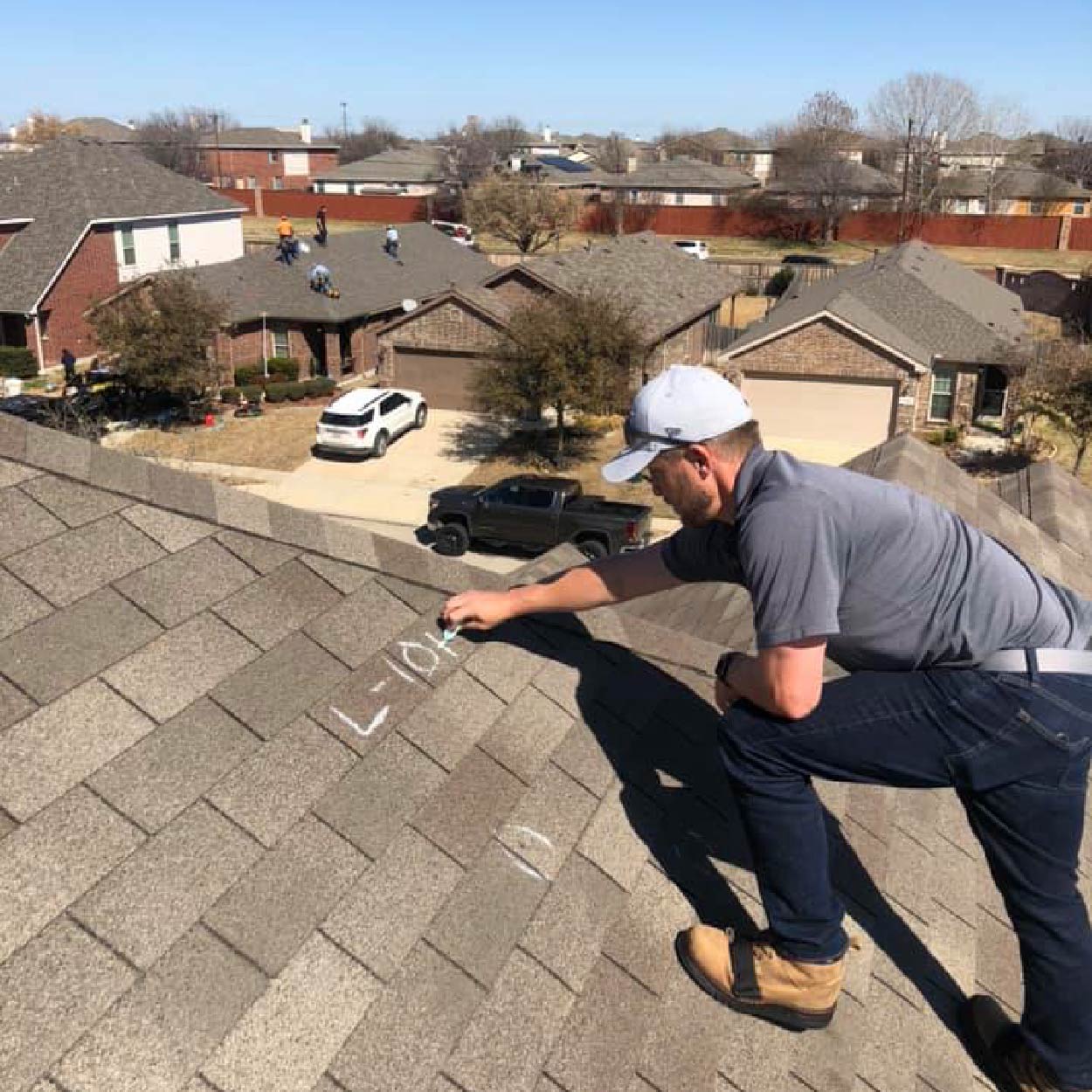
Plenty of what passes for a free roof inspection is a person standing in the yard looking up, or a quick photo taken from the sidewalk. That is not what we do. We get on the roof, we get into the attic where it is accessible, and we examine the roof as a complete system, component by component, because the thing that is actually causing a problem is very rarely the thing you can see from below. What follows is the roof, part by part, the way we walk it.
The field shingles
The broad open areas of shingle, what roofers call the field, are where we start. We look for cracking, curling, blistering, and the creased or lifted tabs that mean wind has folded a shingle without carrying it away. We note the pattern and the location of what we find, because where the wear sits tells us whether we are reading weather, age, or an installation flaw. On a mature Cedar Hill roof, the field often looks acceptable from a distance while telling a very different story up close.
Granule loss and what it signals
The colored granules on a shingle are not decoration, they are the shingle's sunscreen, shielding the asphalt underneath from ultraviolet light. As a roof ages, those granules shed, and once enough are gone the asphalt bakes, hardens, and cracks. We check the field and the gutters for granule loss, because a roof shedding its surface faster than its age would explain is a roof telling you it is closer to the end than the calendar suggests.
Valleys, where the water concentrates
A valley is where two roof planes meet and dump their combined runoff into a single channel, which makes it one of the hardest-working and most leak-prone parts of any roof. We inspect every valley for wear, for lifting, for rust where metal valleys are used, and for debris that has dammed up the channel and forced water sideways under the shingles. On the multi-gabled homes common in Cedar Hill, there are usually several valleys, and each one is a place we look hard.
Flashing at walls
Wherever a roof meets a vertical wall, flashing is what keeps water from running down behind the siding or brick. Step flashing tucked under each shingle course and the counterflashing above it have to be intact and properly lapped, and after decades they often are not. We check every wall intersection, because failed wall flashing is one of the most common sources of the mystery leak that seems to have no cause.
Chimneys and crickets
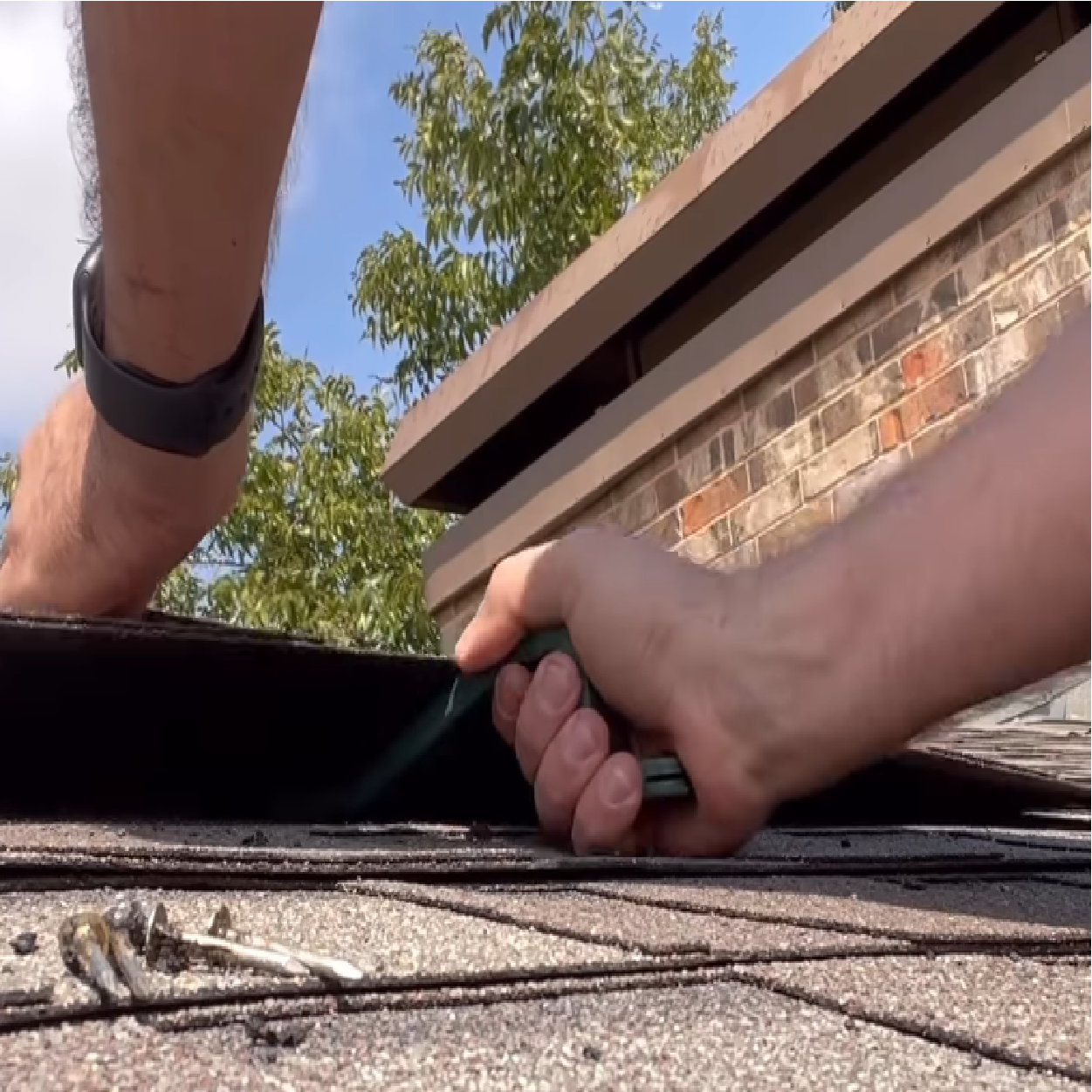
A chimney is a large obstacle sitting in the path of the water coming down the roof, and keeping it dry takes several pieces working together: step flashing up the sides, counterflashing set into the masonry, and a cricket, the small peaked structure behind the chimney that splits the water and sends it around rather than letting it pool against the brick. We inspect all of it, because a chimney with a missing or undersized cricket is a slow leak waiting to happen on any older Cedar Hill home.
Skylights and other penetrations
Every skylight, solar mount, turbine, and satellite bracket is a hole cut in the roof and sealed back up, and every one of them is a candidate for a leak. We inspect the flashing and seals around each penetration individually, because these interruptions in the roof surface fail far more often than the wide-open field between them.
Pipe boots and vents
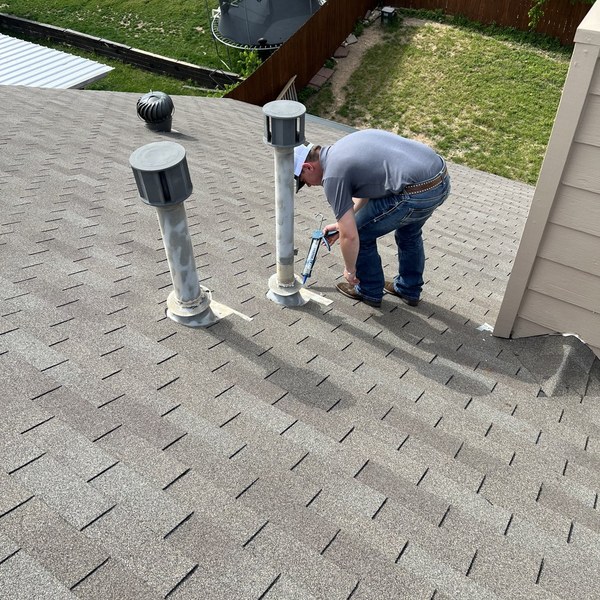
If we had to name the single most common leak point on North Texas roofs, it would be the humble pipe boot, the rubber or lead collar that seals around a plumbing vent. The rubber ones in particular dry out, crack, and split in the Texas sun, usually right around the time the roof hits its teens. We check every boot and vent for cracked collars, loose bases, and rust, because a five-dollar part failing is behind a shocking number of ceiling stains.
Ridge and hip caps
The ridge is the peak where two slopes meet, and the hips are the diagonal seams running down from it, and both are sealed with cap shingles that take the brunt of the wind. On an exposed Cedar Hill roof, these caps are frequently the first thing to lift and lose their seal. We walk every run of ridge and hip and check the caps closely, because once a cap goes, the wind has an open door under the shingles below it.
Drip edge and the rakes
The edges of the roof, the eaves along the bottom and the rakes up the sides, are where wind gets its first grip and where water can wick back under if the drip edge is missing or damaged. We check the perimeter metal and the starter course, because edge failures let a storm begin peeling a roof from its most vulnerable line.
Gutters and drainage
An inspection that stops at the shingles is only half a look. We check the gutters for sagging, separation, and the accumulated granules that betray an aging roof, and we follow where the water goes once it leaves the roof. In Cedar Hill's rolling terrain, poor drainage shows up as eroded soil, rotted fascia, and foundation movement, problems that are far cheaper to catch during a routine roof look than to chase after they have done their damage.
Into the attic
Half of what a roof is doing happens on the underside, so wherever we can safely access the attic, we go in. Daylight showing through the decking, dark water tracks staining the rafters, damp or matted insulation, and a musty smell all point to a leak the surface has been quietly hiding. Very often the attic reveals a problem months before it would ever have shown up as a stain on a bedroom ceiling.
Ventilation, the slow roof-killer
A roof has to breathe. When intake and exhaust ventilation are balanced, air moves through the attic and carries heat and moisture out. When they are not, the attic turns into an oven, the decking stays hot and damp, and the shingles above cook and age from beneath. We assess the ventilation on every Cedar Hill inspection, because in the Texas heat, poor airflow is one of the most common reasons a roof fails years before it should, and correcting it is often the cheapest way to extend a roof's life.
The decking underneath
The decking is the wood surface the whole roof is nailed to, and its condition determines whether a future repair or replacement is straightforward or complicated. Where the attic allows, we check for soft spots, delamination, and staining that reveal a deck already taking on water. On some early-1990s Cedar Hill homes we also find older plank decking rather than modern sheet decking, and knowing that in advance changes the picture entirely.
Reading hail damage
Hail is the damage Cedar Hill homeowners ask about most, and it is also the most misunderstood, because it rarely leaves an obvious hole. Hail bruises a shingle, knocking the granules loose in a random scatter and leaving soft spots where the mat is exposed to accelerate its aging. We inspect the field for that random bruising pattern, and we check the soft metals, the vents, the valleys, the flashing, and the gutters, for the dents and splatter marks that date a storm. The random distribution is what separates true hail from foot traffic or a manufacturing defect.
Reading wind damage
Wind damage looks different from hail and is just as real. It creases and folds shingles, breaks their seals, and lifts or tears tabs, usually concentrated on the slopes facing the prevailing storm direction. On an exposed Cedar Hill roof this is often the dominant form of storm damage, and because a creased shingle that has not yet blown away still looks attached from the ground, it is exactly the kind of harm a casual look misses.
Age versus storm, the line that decides claims
The most important judgment in any inspection is distinguishing genuine storm damage from the ordinary wear a roof accumulates over the years, because that distinction is precisely what an insurance company will argue about. We have walked enough roofs to read the difference honestly, and we will tell you which one you are looking at, even when the answer is not the one that leads to a claim. That honesty is the whole point of getting a real inspection rather than a sales pitch.
The report you walk away with
When the inspection is done, you get a plain-language, photo-documented report. Every finding is shown in a labeled picture, explained in terms a homeowner can follow, and sorted into what is urgent, what can wait, and what is simply worth watching. It is written so that you, a real estate agent, and an insurance adjuster could all read the same document and reach the same conclusion, because ambiguity is what costs homeowners money.
How the insurance claim actually works
If we do find storm damage worth pursuing, understanding the claim process keeps you from leaving money on the table. Most Cedar Hill policies pay in two stages: the carrier first sends the actual cash value, which is the depreciated worth of the damaged roof, and holds back the remainder as recoverable depreciation. That held amount is released once the work is completed and properly invoiced. Homeowners who do not understand this often think the first, smaller check is the whole payout, when in fact a correctly documented and completed job releases the full amount they are owed.
Deductibles, explained honestly
Your deductible is your share of the claim, and there is no legitimate way around it. Any contractor who offers to waive it, absorb it, or make it disappear is inviting you into insurance fraud that ultimately lands on you, not them. We will give you a straight estimate of your realistic out-of-pocket cost up front, so you can decide whether filing a claim even makes sense before you pick up the phone, rather than being blindsided later.
Supplements and code upgrades
Adjusters miss things and prices move, so when the approved scope turns out to be short once work begins, a supplement is the documented request for the legitimate additional cost. Separately, because building codes change over time, a roof replaced today often has to meet requirements the original never did, and many policies carry ordinance-or-law coverage that pays for those mandated upgrades. Both only get honored if someone identifies and documents them, which is part of what our inspection and paperwork are built to do.
Meeting the adjuster on the roof
You do not have to face the insurance adjuster alone, and you should not. We are glad to be on the roof with them, pointing out each documented instance of damage so the assessment reflects what is truly there rather than a hurried look. Time and again, the homeowners who have a knowledgeable roofer beside them during that walk come away with fairer assessments than the ones who leave it to chance.
Drone coverage where it helps
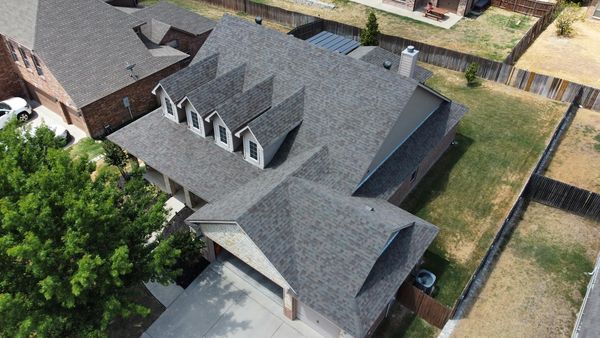
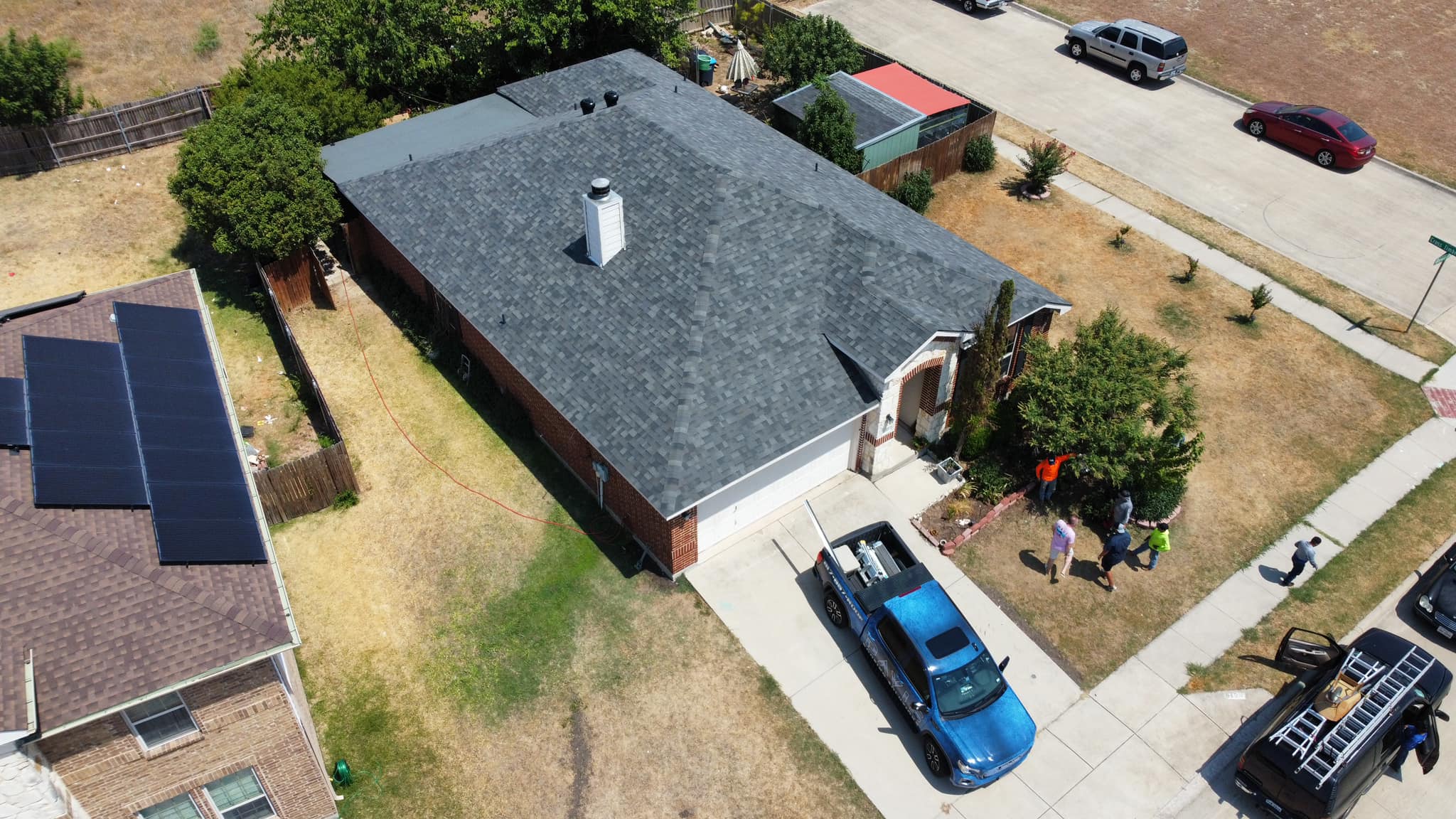
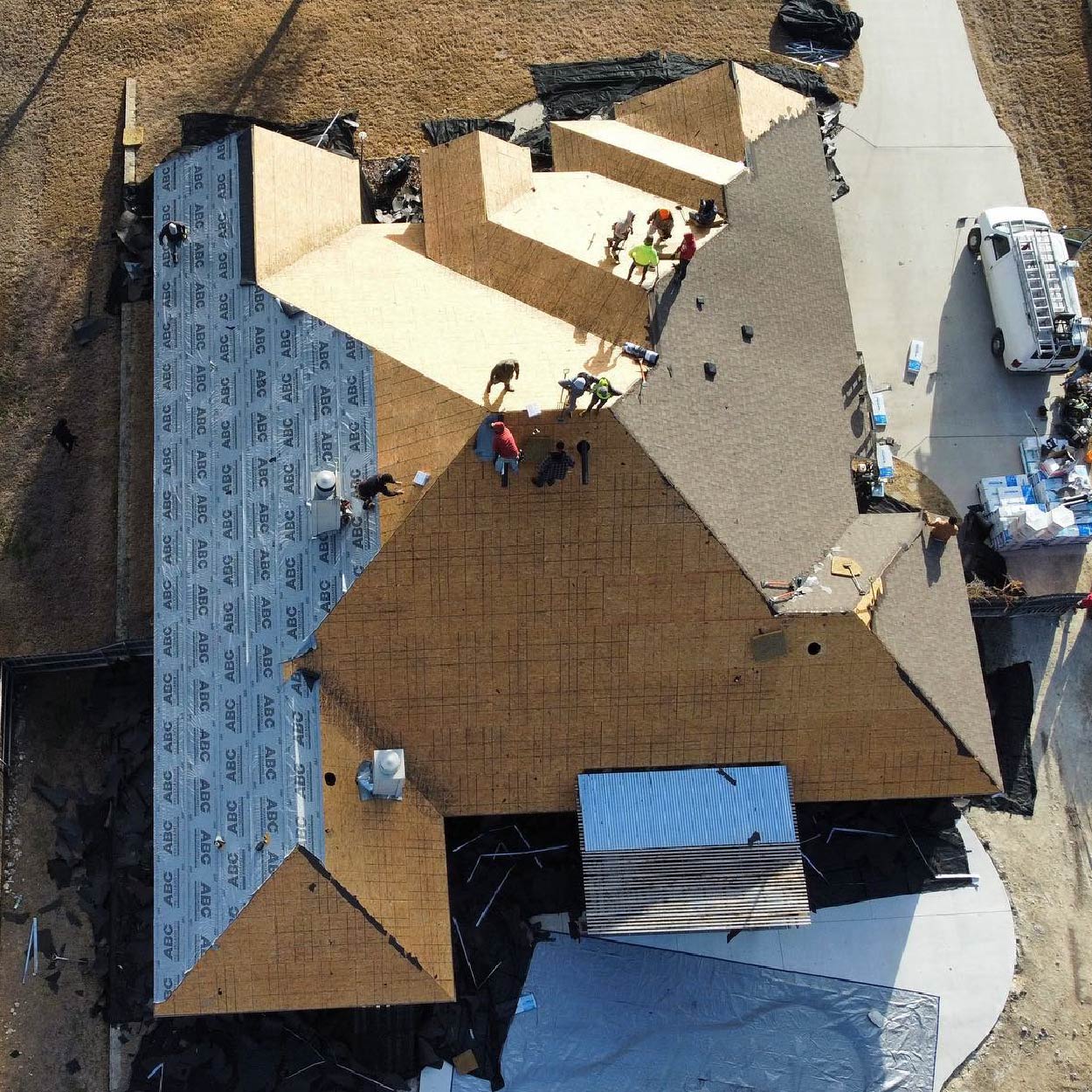
Some Cedar Hill homes are large, steep, or multi-story, with slopes that are genuinely hard to reach on foot, and those awkward areas are exactly where a lazy inspection quietly stops. When a roof calls for it, we use a drone to capture close, detailed imagery of the upper reaches and the far faces, so the inspection covers the entire roof rather than only the convenient parts, and so you can see slopes you have never actually laid eyes on.
Repair, replace, or keep watching
An inspection is only useful if it ends in a clear recommendation, and there are really three honest ones. Sometimes a targeted repair genuinely solves the problem and buys years. Sometimes the roof is worn far enough that spending money on a patch is throwing it away, and replacement is the honest call. And sometimes the right answer is simply to monitor a roof that has life left and plan ahead. We lay out which of the three fits your roof and why, and then the decision is yours.
Selling a Cedar Hill home
If you are preparing to list, an inspection before you put the sign in the yard puts you ahead of the buyer's inspector. You learn what they will find while there is still time to repair it, price it in, or have documentation ready, so the roof does not become the surprise that stalls a closing or knocks thousands off your number at the negotiating table.
Buying a Cedar Hill home
And if you are on the buying side, a roofer's inspection tells you far more than the few minutes a general home inspector can spare for the roof among a hundred other systems. You go into the purchase knowing the true condition and remaining life of one of the home's most expensive components, with documentation that strengthens your position if a repair or credit is warranted.
The value of catching it early
Nearly every expensive roof problem started as a cheap one that nobody caught in time. A cracked boot, a lifted cap, a small piece of failed flashing, addressed today, is minutes of work. Ignored, that same small failure soaks the decking, ruins insulation, stains ceilings, and grows into a repair many times the size. A yearly inspection, plus one after any major storm, is the least expensive insurance a Cedar Hill homeowner can carry.
Local, and here for the long run
Every significant hailstorm brings a wave of out-of-town crews knocking on Cedar Hill doors, and most of them are gone by summer. We are local and year-round, which means the roofer who inspects your roof is the same one who will still be here months later when a question comes up or a claim needs following through. That continuity is worth more than the most polished pitch from someone you will never see again.
Free, thorough, and no obligation
Whatever brought you here, a storm, a stain, a sale, or just the sense that a mature roof deserves a look, a Cedar Hill roof inspection with us is complete, documented, and completely free. There are no strings and no pressure. If your roof is in good shape, we will be glad to tell you so and let you stop worrying about it, and when the day comes that it does need work, we hope the straight dealing is what brings you back to us.
Knowing what is actually on your roof
Part of a good inspection is identifying the covering itself, because different shingles age and fail in different ways. Older Cedar Hill homes sometimes still carry three-tab shingles, the flat single-layer type that weathers faster and is more prone to wind loss. Most have moved to architectural, or laminate, shingles, which are thicker, heavier, and hold up better. And a growing number carry impact-resistant shingles rated for hail. We tell you which one you have and what its condition means, because advice that ignores the material is guesswork.
Impact-resistant shingles and the insurance discount
Impact-resistant shingles, rated Class 3 or the top-tier Class 4, are built to take hail without bruising the way ordinary shingles do, which matters a great deal in a hail-prone spot like Cedar Hill. Many insurers offer a premium discount for a qualifying impact-rated roof, and if you have one, or are considering one, we will point out how it changes both your storm risk and potentially your policy. It is one more piece of the picture a real inspection surfaces.
When a leak cannot wait
Sometimes an inspection turns up damage that is actively letting water in, and that cannot sit until a convenient date. If we find an urgent problem, we can get a proper temporary cover over it quickly to stop the water, protecting your ceilings, insulation, and belongings while the permanent repair is arranged. A dried-in cover is not the fix, but it keeps a bad situation from getting worse while the real work is scheduled.
Moss, algae, and the shaded slopes
Cedar Hill's mature trees and hilly, sometimes damp microclimate feed the dark algae streaking you see on many roofs, and on the shaded north-facing slopes, the beginnings of moss. Both hold moisture against the shingles and quietly shorten their life, and moss in particular can lift shingle edges as it grows. We flag it where we find it and explain what it means, because the shaded slopes of a Cedar Hill roof often age faster than the sunny ones and deserve a closer look.
Protecting your property during the visit
An inspection should leave no trace on the home itself. We work carefully around landscaping, keep off delicate surfaces, and take care not to damage the very roof we are examining, because a careless inspector who cracks a brittle shingle or dents a soft-metal vent has created a problem instead of finding one. Respecting the property is part of doing the job right.
What happens after the report
Handing you the report is not the end of the conversation. We walk you through what we found, answer your questions in plain language, and lay out your options without any pressure to decide on the spot. Whether that means scheduling a repair, planning a replacement down the road, filing a claim, or simply putting the report in a drawer for peace of mind, the next step is entirely yours, and we are here whenever you are ready to take it.
Common Cedar Hill roof inspection questions
How long does an inspection take? For most Cedar Hill homes, a thorough inspection runs somewhere between forty-five minutes and an hour and a half, depending on the size and complexity of the roof and whether the attic is accessible. We would rather take the time to do it right than rush through and miss something.
Is it genuinely free? Yes. The inspection costs nothing and carries no obligation. We make our living doing quality roof work for people who trust us, and an honest inspection is how that trust starts, not something we need to charge for.
Do I need to be home? It helps but it is not required. If you are home, we can walk you through what we found in person, but we are also glad to do the inspection and send you the documented report if your schedule does not allow it.
How often should I have my roof inspected? Once a year is a sound baseline for a mature Cedar Hill roof, and you should add an inspection after any major hail or windstorm. Getting on a regular cadence is what keeps small, cheap problems from quietly becoming large, expensive ones.
I do not see any damage. Is an inspection still worth it? Almost always, yes. The whole reason storm and wear damage is dangerous is that it hides from the ground. A roof that looks perfectly fine from the driveway can have creased shingles, bruised field, or a cracked boot that only a close look reveals.
Will you actually get on the roof? Yes, whenever it is safe to do so, and into the attic where it is accessible. We do not diagnose a roof from the sidewalk. Where a slope is genuinely too steep or unsafe to walk, we use a drone so that area still gets inspected rather than skipped.
My roof is only a few years old. Do I still need one? A newer roof benefits from an inspection too, because production roofs sometimes carry installation shortcuts that only reveal themselves under a few years of Texas weather. Catching one early, while it is minor, is exactly the point.
If you find damage, am I obligated to hire you? Not at all. The report is yours to use however you like, including getting other opinions. We would rather earn your business with an honest inspection than trap you into anything.
How can you tell hail damage from ordinary wear? Hail leaves a random scatter of bruises and knocks granules loose in a distinctive pattern, and it dents the soft metals in a way age never does. Ordinary wear is more uniform and predictable. Reading that difference correctly is one of the most valuable things an experienced roofer brings to an inspection.
Do you help with the insurance claim? Yes. If we find legitimate storm damage, we document it thoroughly, explain how the claim process works, and are glad to meet your adjuster on the roof to make sure the assessment reflects the real condition of your Cedar Hill roof.
What exactly is in the report? Labeled photos of every finding, a plain-language explanation of what each one means, drone imagery where we used it, and a clear breakdown of what is urgent, what can wait, and what is simply worth monitoring. It is written to be read by a homeowner, an agent, or an adjuster alike.
What if the roof turns out to be fine? Then we will tell you so plainly and you can stop worrying about it. A clean inspection is a perfectly good outcome, and giving you that peace of mind for free is a fair trade for the chance to earn your trust when you do eventually need work done.
Reading a roof's remaining life
One of the most useful things an inspection gives a Cedar Hill homeowner is an honest read on how many years a roof has left. That is not a number off the warranty, it is a judgment built from the shingle's flexibility, its granule cover, the condition of the seals, the state of the flashing and boots, and how the decking looks from below. We would rather tell you that you have five good years left and to plan accordingly than pressure you into replacing a roof that is not done, or let you coast on one that is about to fail.
Low-slope and flat sections
Many Cedar Hill homes have a porch, a patio cover, or an addition with a low-slope or nearly flat section, and those areas play by different rules than the steep main roof. Water moves slowly across them and ponds where it should drain, so the seams and the membrane matter far more than shingles would. We inspect those sections specifically, because a low-slope area handled like a steep roof is a leak waiting to happen.
Tree debris and the shaded gutter
Cedar Hill's mature tree canopy is part of the city's charm and part of its roofing challenge. Leaves and twigs collect in valleys and gutters, hold moisture against the roof, and dam up the drainage that keeps water moving. We note where debris is building and where overhanging limbs are wearing on the shingles or dropping into the gutters, because a roof problem that starts as a clogged valley is one of the most common and most preventable we see here.
Insulation, and what a wet roof ruins
A roof leak rarely stops at the roof. Water that gets past the decking soaks the attic insulation below, and wet insulation loses much of its R-value and stays damp long enough to invite mold and wood rot. When we find staining or moisture up there, we point out not just the roof problem but the insulation it may already be ruining, because on a Cedar Hill home the hidden damage under a small leak is often the more expensive half of the story.
An inspection with no sales quota behind it
The value of an honest inspection is that the person doing it has no reason to find damage that is not there. We are not working a commission on a new roof, so when your Cedar Hill roof is genuinely fine, we say so and move on. That single fact, that we will happily deliver good news, is what separates a real inspection from a sales call dressed up as one.
A roof file for the life of the home
Every inspection we do becomes part of a record you can keep for the life of the home: what the roof looked like, what shape it was in, and what, if anything, was done about it. That file is worth real money when you sell, it settles arguments with insurers, and it means the next inspection has a baseline to measure against. On a home you plan to hold, that history compounds in value.
Do you inspect flat or low-slope roofs too? Yes. We inspect the low-slope porches, patio covers, and additions that many Cedar Hill homes have, and we evaluate them on their own terms, since they drain and fail differently than the steep main roof.
Can you inspect a home I am about to buy? Yes, and it is one of the smartest things a buyer can do. As covered in the buying section above, you get a far deeper read on the roof than a general home inspection gives it, with documentation you can take to the negotiating table.
What areas do you cover? We work throughout Cedar Hill and the surrounding Best Southwest communities and across the wider Dallas-Fort Worth Metroplex. Wherever you are, the inspection is the same thorough, documented, no-cost look.
Is there any charge for the report or the photos? None. The inspection, the photo-documented report, and any drone imagery we capture are all free and yours to keep, whether or not you ever hire us for work.
How soon can you come out? Usually within a few days, and faster when there is an active leak that cannot wait. If a storm has just rolled through and you are worried, tell us and we will prioritize getting eyes on your roof.
What if I just want peace of mind? That is a perfectly good reason to call. Plenty of the Cedar Hill inspections we do turn up nothing urgent, and the homeowner simply wanted to know where they stand. Giving you that answer, in writing and for free, is exactly what we are here for.